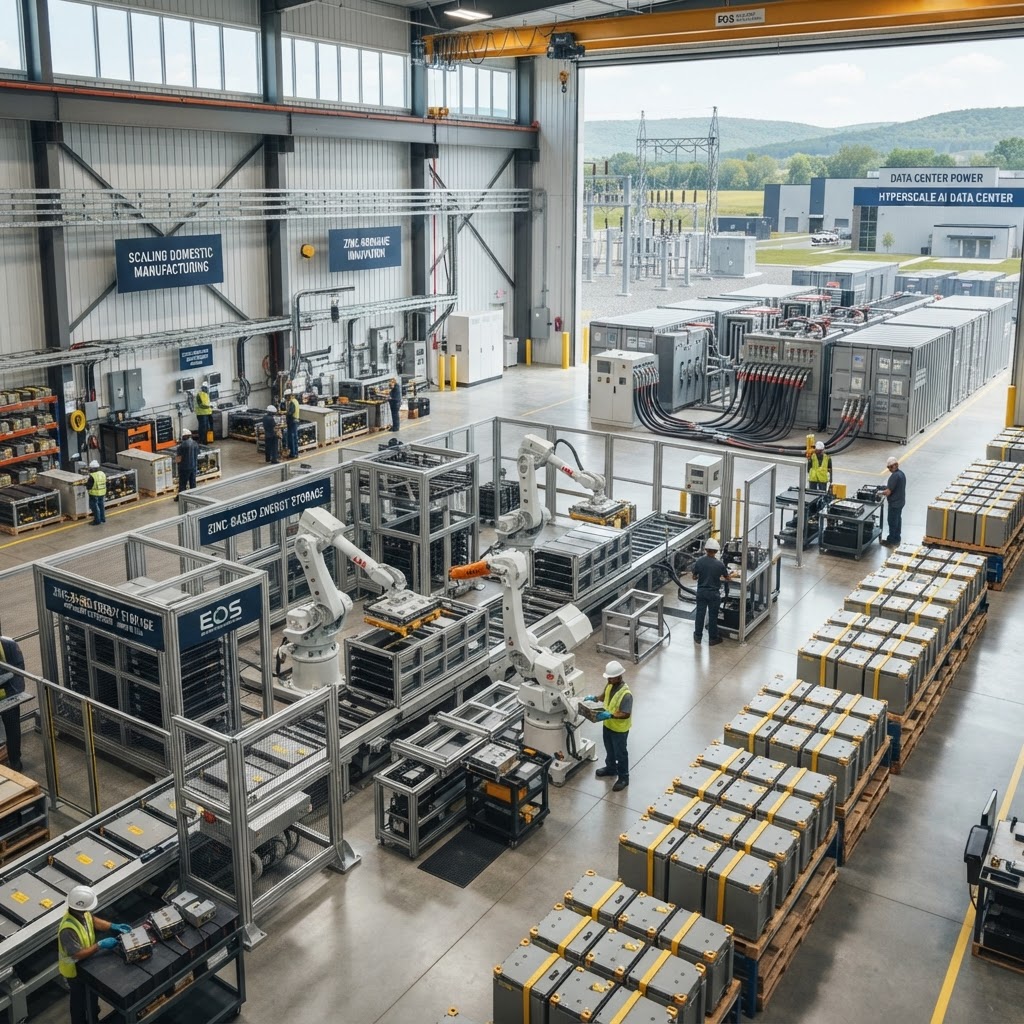
Eos Energy Enterprises has officially commenced commercial production at its new Thorn Hill manufacturing facility in Marshall Township, Pennsylvania, marking a pivotal expansion in domestic long-duration energy storage (LDES) capacity. By successfully completing site acceptance testing for its second battery line, the company is accelerating its transition from pilot-scale manufacturing to high-volume output. This milestone arrives as the energy sector faces unprecedented pressure to provide reliable, non-flammable power solutions for AI-driven data centers. Eos’s proprietary zinc-bromine chemistry offers a strategic alternative to lithium-ion, providing the operational flexibility required to manage the intensive, multi-hour discharge cycles essential for modern hyperscale computing infrastructure.
Key Findings
The expansion is underpinned by significant federal support, including a $305.3 million loan guarantee from the U.S. Department of Energy’s Loan Programs Office, finalized in late 2024. This capital has been instrumental in constructing state-of-the-art production lines designed to manufacture the company’s next-generation Eos Z3™ battery architecture. Unlike traditional lithium-ion systems, Eos’s zinc-based technology is inherently non-flammable and does not require active cooling, reducing both operational complexity and fire-risk profiles for industrial sites. The company’s ability to scale domestic production is a critical hedge against supply chain volatility, ensuring that critical infrastructure projects can source reliable, U.S.-manufactured storage systems. Furthermore, the integration of AI-enabled controls, such as the company’s DawnOS™ platform, allows for optimized energy management, enabling operators to maximize the efficiency of their storage assets in real-time, high-demand environments.
Industry Response
Market analysts and energy sector stakeholders have noted that Eos’s pivot toward AI-specific infrastructure is a timely response to the 'electrification of everything.' By partnering with firms like TURBINE-X Energy, Eos is positioning its storage systems as a core component of private, on-site power solutions that combine gas-fired generation with long-duration storage. This hybrid approach is increasingly viewed as the gold standard for data center developers who cannot wait for traditional grid upgrades. Industry observers highlight that the company’s focus on 'mid-duration' storage—ranging from 4 to 16 hours—fills a vital gap in the market that lithium-ion systems often struggle to address cost-effectively. The successful commissioning of the Thorn Hill facility serves as a proof-of-concept for the viability of U.S.-based manufacturing, demonstrating that domestic firms can successfully scale complex energy hardware when supported by targeted federal financing and clear commercial demand from the technology sector.
What's Next
The immediate focus for Eos is the continued ramp-up of production at the Thorn Hill facility, with eyes on further capacity expansion in Duquesne, Pennsylvania, pending final environmental assessments and regulatory approvals. As the company scales, the primary catalyst will be the deployment of its integrated power solutions for hyperscale AI clients, who require rapid, reliable energy infrastructure to meet aggressive operational timelines. Investors are closely watching the company’s ability to maintain cost-competitiveness as it moves toward full-scale manufacturing. Additionally, the company is expected to continue refining its AI-enabled software suite, which is essential for managing the complex, decentralized energy grids of the future. With a robust commercial pipeline and federal backing, Eos is well-positioned to capture a significant share of the growing market for non-lithium energy storage, provided it can maintain its current trajectory of operational execution and supply chain stability through 2027.