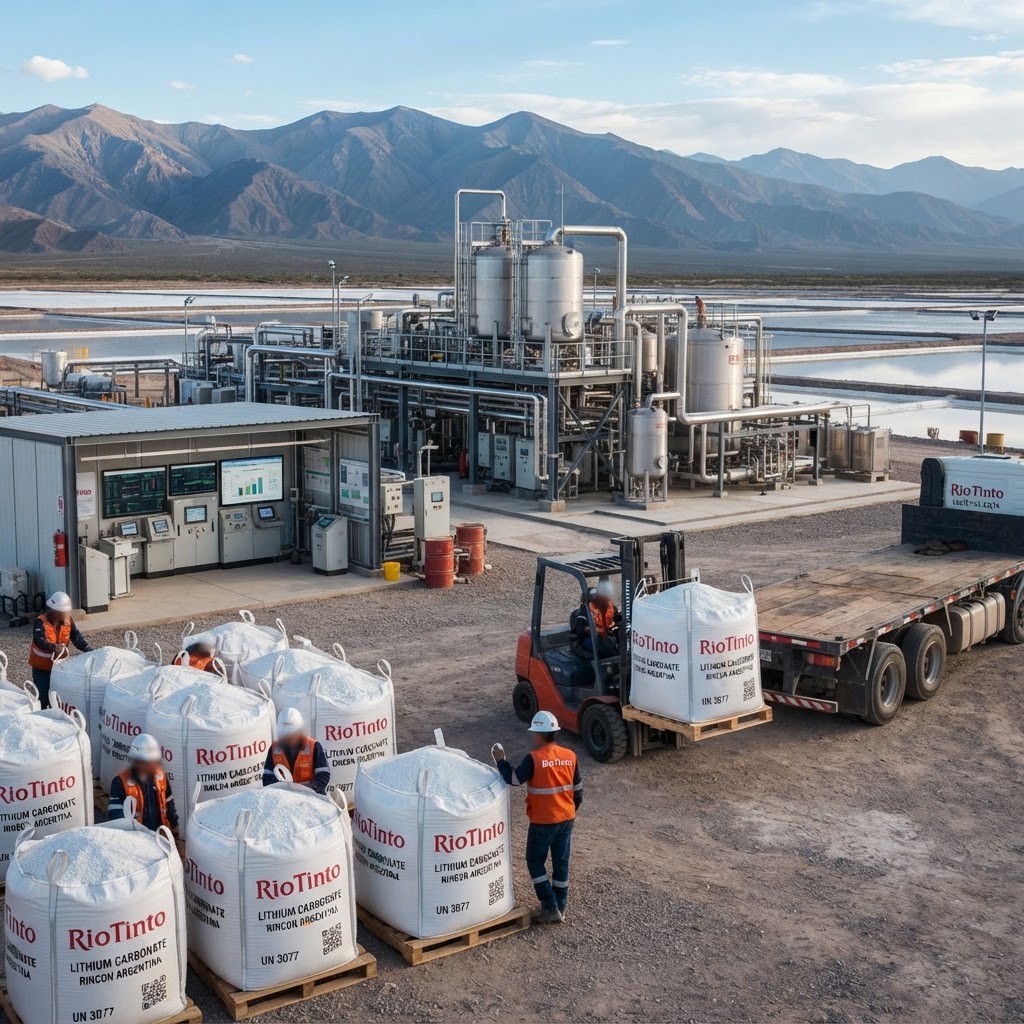
Rio Tinto has officially commenced commercial lithium exports from its Rincon project in Argentina, marking a pivotal operational milestone for the mining giant. The company confirmed the shipment of 200 tonnes of battery-grade lithium carbonate from the Port of Buenos Aires, destined for markets in Shanghai. Located in the heart of the Lithium Triangle in Salta province, the Rincon asset is central to Rio Tinto’s strategy to scale its battery materials portfolio. This initial output originates from the site’s 3,000-tonne starter plant, serving as a critical proof-of-concept for the company’s broader, long-term production ambitions in the region.
Key Findings
The Rincon project represents a significant expansion of Rio Tinto’s footprint in the energy transition sector. Following an initial $825 million acquisition in 2022, the company has committed a further $2.5 billion to scale the operation to a total annual capacity of 60,000 tonnes of battery-grade lithium carbonate. The project is designed for a 40-year mine life, leveraging advanced brine processing techniques. Current estimates indicate measured resources of 1.54 million tonnes of lithium carbonate equivalent (LCE), with an additional 7.85 million tonnes in indicated resources and 2.29 million tonnes in inferred resources. Probable ore reserves are currently pegged at 2.07 million tonnes of LCE. By integrating the starter plant’s performance data with the scale of the planned 57,000-tonne expansion, Rio Tinto aims to establish a low-cost, high-efficiency production hub that can withstand market volatility while meeting the surging demand for electric vehicle battery components globally.
Industry Response
The project has garnered significant attention from both industry analysts and government officials, particularly as Argentina seeks to solidify its position as a premier global lithium supplier. During a recent investment summit in New York, the progress at Rincon was highlighted as a success story for the current administration’s efforts to attract foreign capital through marquee incentive packages. Rio Tinto leadership has emphasized that the company is moving beyond experimental phases, noting that the successful operation of the starter plant has validated their technical approach. By leveraging decades of operational experience—bolstered by the integration of assets like those from Arcadium Lithium—the company is positioning itself to deploy proven, scalable technology rather than relying on unverified processes. Market observers view this milestone as a vote of confidence in the long-term outlook for lithium, suggesting that major miners are increasingly comfortable with the technical and geopolitical risks associated with large-scale brine extraction in the Lithium Triangle.
What's Next
The path forward for Rincon is defined by a rigorous construction and ramp-up schedule. With the starter plant now operational and exporting, the focus shifts to the construction of the 57,000-tonne expansion plant, which is currently underway. This facility is scheduled to come online in 2028, with a three-year ramp-up period required to reach full nameplate capacity. Financing for this next phase has been bolstered by a $1.175 billion project loan, providing the necessary liquidity to maintain momentum. Beyond the physical construction, Rio Tinto continues to optimize its processing efficiency through debottlenecking programs. The company is also monitoring the broader regulatory environment in Argentina, which remains a critical variable for project timelines. As the industry watches the 2028 commissioning date, the success of the Rincon expansion will likely serve as a benchmark for how major diversified miners manage the transition from traditional commodities to the high-growth, technology-intensive battery materials market.