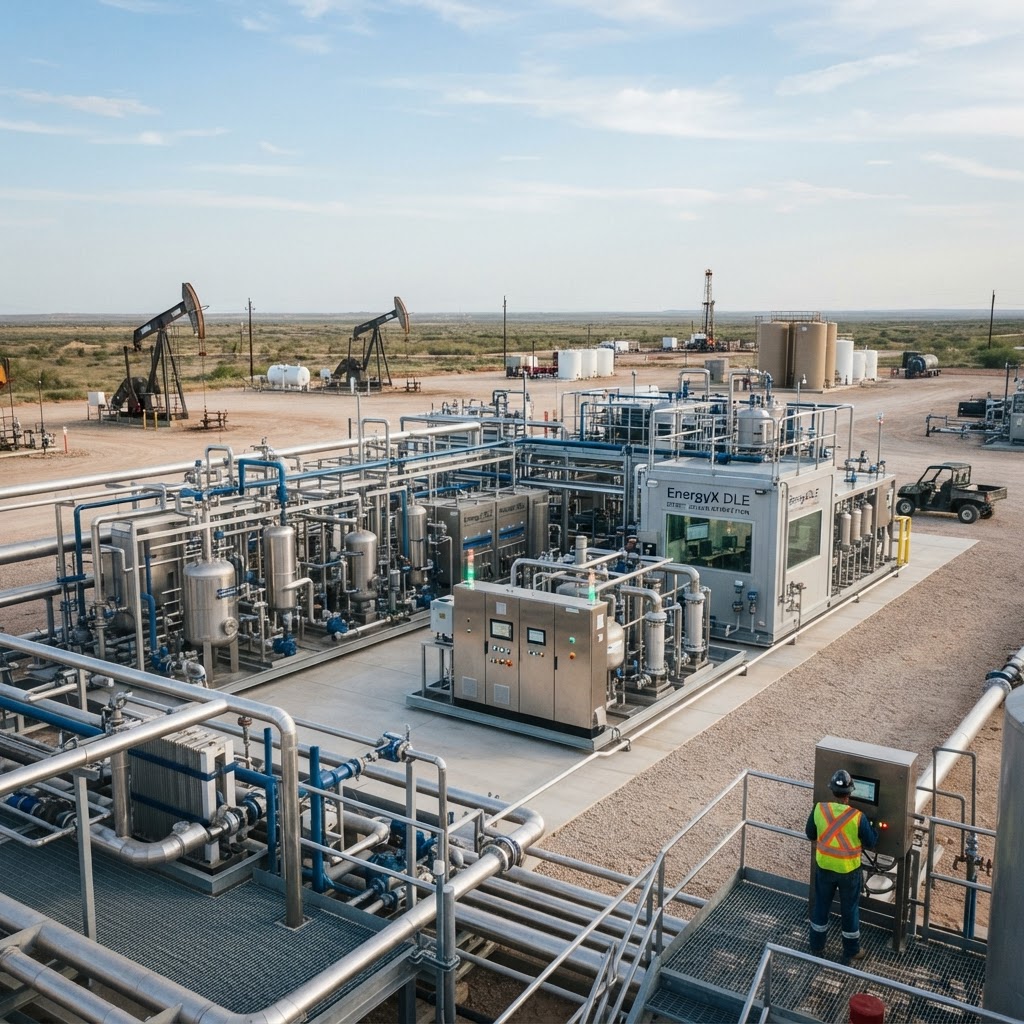
Energy Exploration Technologies (EnergyX) has officially commissioned its Project Lonestar facility in Texas, marking a pivotal advancement for domestic lithium production. As the largest direct lithium extraction (DLE) plant of its kind in the United States, the site is now processing Smackover brine to produce approximately 250 metric tons per year of battery-grade lithium hydroxide. This milestone represents a critical step in validating scalable, cost-competitive extraction pathways on U.S. soil. By utilizing its proprietary GET-Lit technology, EnergyX aims to bridge the domestic supply chain gap, reducing reliance on overseas conversion capacity and establishing a robust technical foundation for future commercial-scale deployments across its growing North American resource portfolio.
Key Findings
The commissioning of Project Lonestar serves as a technical proof-of-concept for EnergyX’s integrated extraction and refining platform. By processing local Smackover brine, the facility demonstrates high recovery rates and operational efficiency under real-world industrial conditions. The project is designed to validate process economics, allowing the company to optimize system design before scaling to its planned 100,000-ton annual capacity. A primary finding from the initial startup phase is the ability to produce battery-grade lithium hydroxide directly from brine in a significantly shorter timeframe than traditional evaporation methods, which typically require 12 to 18 months. Furthermore, the facility provides the necessary throughput to supply 5-25 ton samples to potential EV and energy storage customers for qualification. This data-driven approach to refining is expected to lower the overall cost profile of domestic lithium, positioning EnergyX as a competitive player in the global market. The successful integration of membrane-based separation and solvent extraction at the Texas site confirms that the company’s modular flow sheet can handle complex brine compositions while maintaining high purity levels required for modern battery manufacturing.
Industry Response
Industry analysts and stakeholders view the Lonestar commissioning as a necessary correction to the current lithium supply chain bottleneck. With China controlling roughly 70% to 75% of global lithium chemical conversion, the ability to refine material domestically is seen as a strategic imperative for U.S. energy security. Teague Egan, Founder and CEO of EnergyX, emphasized that the facility validates the company’s performance at an industrial scale, stating that the project establishes a foundation for the lowest-cost production in the U.S. market. The broader industry, including battery manufacturers and automotive OEMs, has closely monitored the project as a bellwether for DLE viability. By providing a transparent, domestic source of battery-grade material, EnergyX is addressing the margin suppression issues that have historically made non-Chinese conversion uneconomic. Policymakers and trade groups have also noted that such projects are essential for meeting the growing demand for critical minerals, as they provide a pathway to reduce geopolitical risk. The successful deployment of the Lonestar plant is expected to encourage further capital investment into the DLE sector, as it proves that advanced extraction technologies can move from laboratory settings to operational, revenue-generating assets.
What's Next
Following the successful commissioning of Project Lonestar, EnergyX is shifting its focus toward commercial expansion and the development of its broader U.S. footprint. A primary catalyst on the horizon is the advancement of Project Powder Hound, a planned 30,000-ton-per-annum commercial facility near Utah’s Great Salt Lake. Developed in partnership with Compass Minerals, this project is expected to leverage the technical insights gained from the Texas demonstration plant to scale production significantly. EnergyX has committed approximately $400 million to the Utah project, which is slated to proceed in two phases. Additionally, the company continues to refine its membrane manufacturing capabilities in Austin, Texas, to support the global deployment of its GET-Lit platform. Investors are now looking toward the 2026-2030 timeline, during which EnergyX aims to reach its 100,000-ton production target. Future milestones include the qualification of battery-grade samples by major automotive partners and the potential for further licensing agreements with resource owners seeking to implement DLE technology. As the company scales, the focus will remain on maintaining low capital expenditure costs—currently targeted at $12,500 per ton—while ensuring the environmental sustainability of its brine-to-battery process. These developments will be critical in determining the company's long-term trajectory as a fully integrated lithium producer.