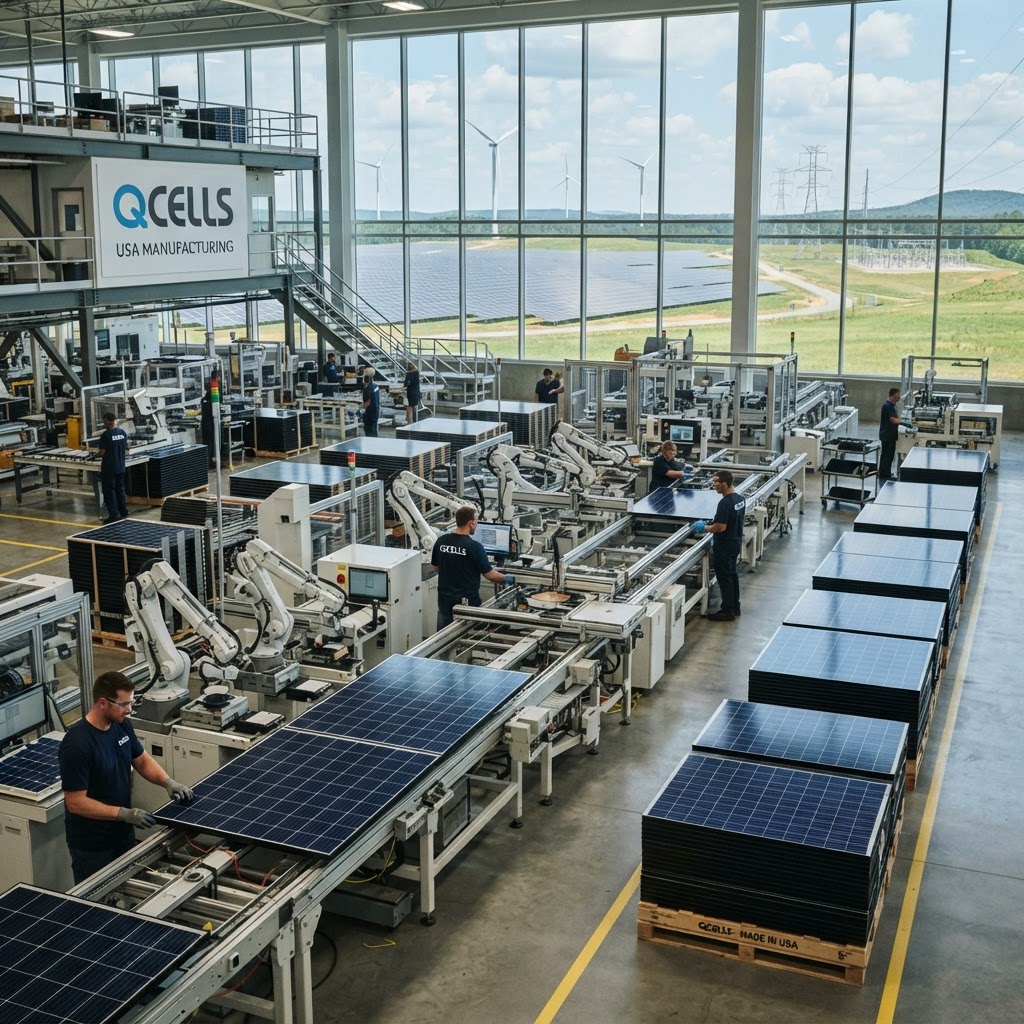
Qcells is doubling down on its domestic manufacturing strategy, announcing the launch of two new US-produced residential AC solar panels, the Q.TRON AC and Q.PEAK DUO AC. This expansion, slated for completion by the end of 2026, marks a significant step in the company’s effort to build a fully vertically integrated solar supply chain within the United States. By producing these advanced modules at its Georgia facilities, Qcells aims to provide installers and homeowners with reliable, domestically sourced technology. This move underscores the company’s commitment to insulating the American solar market from global supply chain volatility while reinforcing its position as a cornerstone of the nation’s clean energy industrial base.
Key Findings
The expansion leverages Qcells’ existing 5.1GW manufacturing capacity in Dalton, Georgia, and its state-of-the-art Cartersville complex, which remains the only facility in the US capable of producing ingots, wafers, cells, and finished modules under one roof. By integrating AC technology—which includes microinverters directly on the panel—Qcells is streamlining the installation process for residential contractors. This vertical integration is supported by strategic partnerships, including collaboration with the ALUKO Group, which provides essential module frame extrusion and anodizing services domestically. These efforts are designed to mitigate the impact of trade uncertainties and logistics disruptions that have historically plagued the solar sector. The company’s ability to maintain consistent production, following a brief operational pause earlier in 2026, highlights the resilience of its domestic manufacturing model and its alignment with federal incentives aimed at re-shoring critical energy infrastructure.
Industry Response
Industry analysts and company leadership view this development as a vital maturation of the US solar ecosystem. Il Hyeong No, head of Qcells North America, emphasized that the company is deeply committed to investing in American-made clean energy products and the domestic supply chain that supports them. Market observers note that by controlling the manufacturing process from raw silicon to the finished AC panel, Qcells is effectively shielding its customers from the price fluctuations and regulatory hurdles associated with imported components. Furthermore, the project has garnered bipartisan support in Georgia, where local leaders have championed the Cartersville factory as a model for industrial revitalization. The shift toward domestic production is increasingly seen as a necessary hedge against global trade policy shifts, providing a stable pathway for residential solar adoption despite the complex and evolving landscape of international energy trade.
What's Next
The immediate focus for Qcells is the full-scale rollout of the Q.TRON AC and Q.PEAK DUO AC lines, with commercial availability expected by late 2026. Beyond product launches, the company is monitoring the broader impact of federal loan support and tax credit stability on its long-term capital expenditure plans. As the US solar industry continues to navigate shifting trade policies, Qcells’ ability to scale its domestic output will be a key indicator of the sector's overall health. Future milestones include the continued optimization of the Cartersville facility’s throughput and the potential for further downstream integration. Investors and grid operators will be watching closely to see how these domestically produced panels perform in the field, as they represent a critical component in the broader effort to modernize the residential energy landscape and meet rising electricity demand through reliable, locally manufactured renewable solutions.