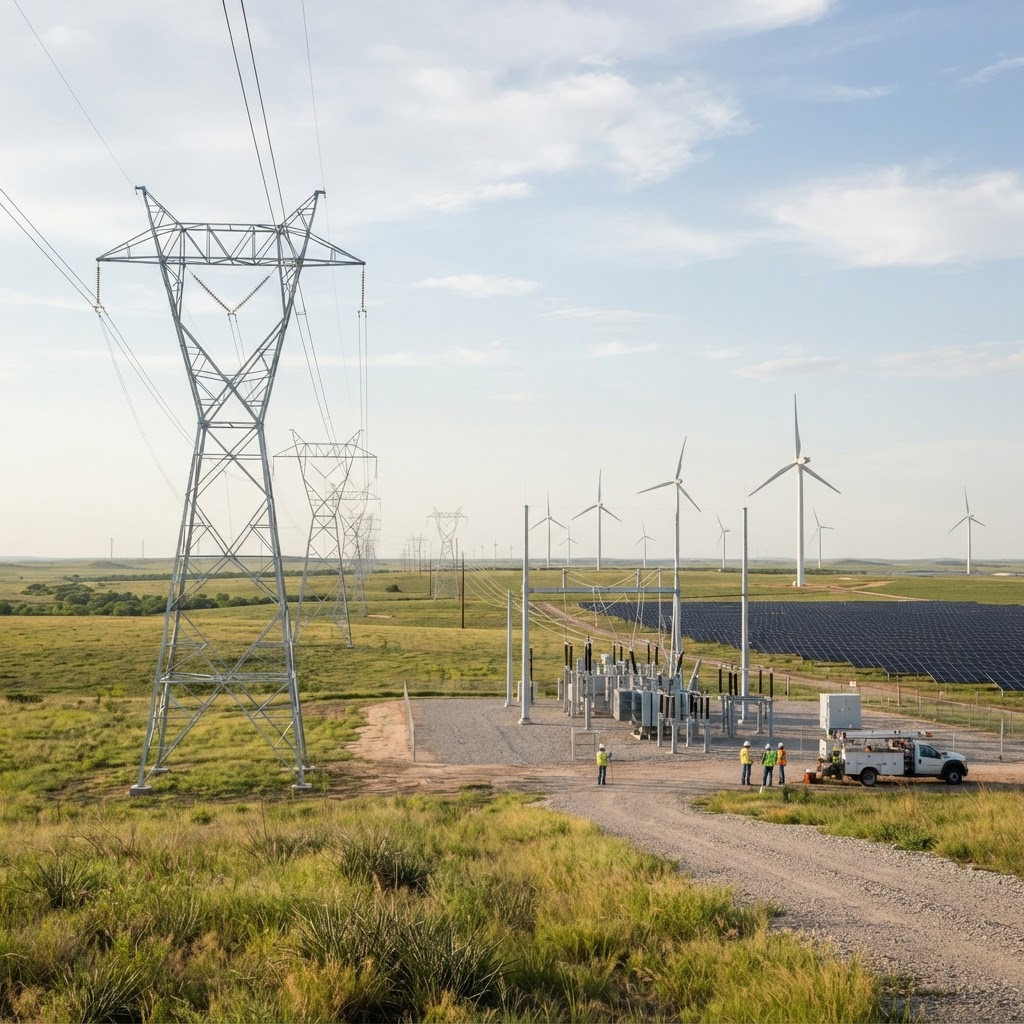
The U.S. Department of Energy has finalized a landmark $3.26 billion loan to AEP Texas, marking a significant milestone in the federal push to modernize aging infrastructure and bolster regional grid resilience. The financing, issued through the Office of Energy Dominance Financing, will support the reconstruction and upgrade of approximately 2,800 miles of transmission lines across the state. This capital injection represents one of the largest federal commitments to domestic power delivery systems to date, targeting critical bottlenecks that have historically limited industrial growth. By prioritizing "speed-to-power" and reliability, the initiative aligns with a broader policy shift toward enhancing domestic energy security while accommodating surging electricity demand from new manufacturing and data center corridors.
Key Findings
The $3.26 billion loan to AEP Texas is structured to finance a comprehensive suite of approximately 100 individual transmission projects, according to DOE closes up to $3.26B loan to AEP Texas. These upgrades are designed to replace aging wooden poles with robust steel structures and higher-capacity conductors, effectively increasing the thermal limits and throughput of the existing network. A central component of this policy shift is the utilization of the Energy Dominance program, which was revitalized under the OBBBA legislation. As noted in Title XVII: From Clean Energy Innovation to Energy Dominance, this framework authorized up to $250 billion in new loan guarantees, specifically removing previous requirements that projects must sequester or reduce emissions, instead focusing on "system adequacy" and "grid reliability." The AEP Texas deal serves as a primary case study for this transition, demonstrating how federal credit assistance can de-risk large-scale infrastructure investments that might otherwise face capital availability gaps. Furthermore, the project is expected to unlock significant economic development in high-priority geographic areas, including semiconductor clusters and industrial parks that have been delayed by grid constraints. By modernizing 2,800 miles of the Texas grid, the initiative provides a scalable model for other regional utilities seeking to integrate large-scale generation and meet the needs of a rapidly electrifying economy.
Industry Response
Industry leaders and policymakers have hailed the loan as a vital step toward securing the nation’s energy future. Secretary Wright emphasized in Energy Secretary Announces Cancellation of Three Proposed National Interest Electric Transmission Corridors that transmission policy must prioritize "affordable, reliable, and secure electricity" for American families, distancing the current administration’s strategy from previous agendas. This sentiment is echoed by utility executives who view the federal support as a catalyst for long-term economic stability. Matt Valle, president of NextEra Energy Transmission, noted in NextEra Energy Transmission and Exelon Welcomed PJM Board Vote that such infrastructure is "a win for residents and a win for the local economy," highlighting the "speed-to-power" efficiency now being demanded by the sector. Analysts at Bracewell LLP pointed out that the evolution of DOE financing allows for a more pragmatic approach to grid hardening. By focusing on projects that "increase capacity or output," the DOE is addressing the immediate reality of outpacing demand. Trade groups have also noted that this level of federal backing helps stabilize electricity prices by reducing the long-term costs of congestion and emergency repairs, providing a predictable environment for private capital to follow into the transmission space.
What's Next
The closing of the AEP Texas loan sets the stage for a multi-year construction cycle, with several high-priority segments expected to break ground by late 2026. Investors are now looking toward the remaining $246 billion in authorized loan guarantee capacity under the Energy Dominance program, as the DOE seeks to identify additional "high-priority geographic areas" for targeted investment, as detailed in DOE Relaunches Financial Support. These zones likely include data center corridors and port complexes where grid constraints currently limit high-value investment. Concurrently, the industry is monitoring the implementation of FERC Order 1920, which mandates that transmission owners evaluate grid-enhancing technologies (GETs) like dynamic line rating to further maximize capacity, according to Smart Transmission Tools Modernize America’s Power Grid. The DOE is also expected to release new guidance on "de-risking early-stage infrastructure" to attract more private capital into interregional projects. As the 2026 Critical Minerals Ministerial approaches, the nexus between grid reliability and the domestic processing of battery materials will become a central policy theme. For AEP Texas, the immediate focus remains on procurement and workforce scaling to meet the ambitious 2,800-mile upgrade target, a project that will serve as a bellwether for the efficiency of federal-private partnerships in the energy sector.