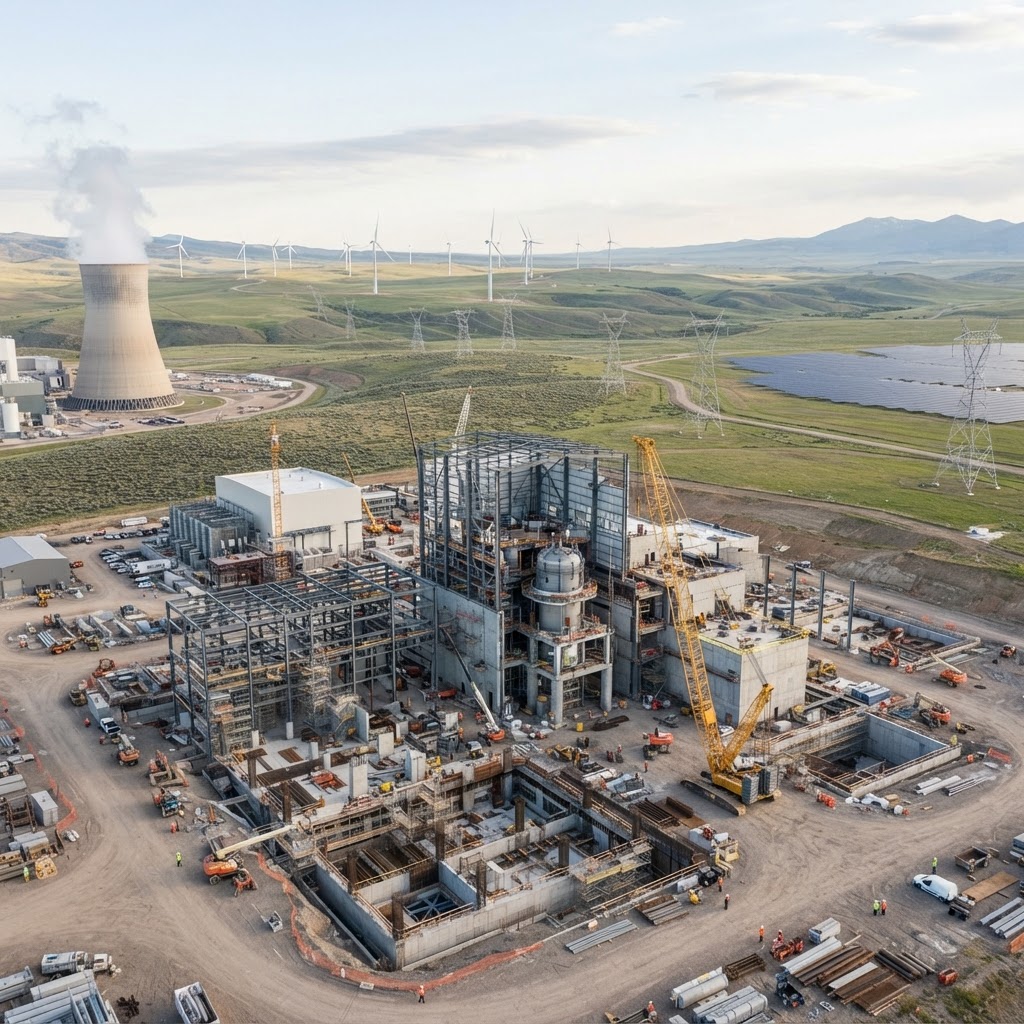
TerraPower has officially entered the construction phase for its pioneering Natrium reactor in Kemmerer, Wyoming, marking a watershed moment for the U.S. advanced nuclear sector. Following the U.S. Nuclear Regulatory Commission’s issuance of a construction permit, the company is mobilizing a 1,600-strong workforce to transform a retired coal plant site into a hub for next-generation, carbon-free baseload power. This project, supported by the Department of Energy’s Advanced Reactor Demonstration Program, represents the first utility-scale advanced nuclear plant in the Western Hemisphere. With commercialization efforts already accelerating, TerraPower is positioning its sodium-cooled technology as a critical, flexible solution for modern grids struggling to balance rising demand with intermittent renewable energy sources.
Key Findings
The Natrium project distinguishes itself through a unique 345-megawatt sodium fast reactor design integrated with a molten salt energy storage system. This configuration allows the plant to adjust its power output to complement high-renewable penetration grids, effectively acting as a massive, dispatchable battery. The project is a cornerstone of the U.S. Department of Energy’s Advanced Reactor Demonstration Program (ARDP), which provides a 50/50 cost-share structure to de-risk first-of-a-kind deployment. Recent regulatory milestones, including the successful completion of the Environmental Impact Statement and the issuance of construction permit CPAR-1, underscore the project's technical viability. Furthermore, TerraPower is concurrently constructing a sodium test and fill facility on-site to validate equipment performance before full-scale reactor operations commence. These infrastructure investments are designed to establish a resilient supply chain, with the company already awarding multiple vendor contracts to ensure the project remains on track for its 2030 completion target.
Industry Response
The project has garnered significant support from both policymakers and industrial partners who view it as a blueprint for the future of energy. U.S. Senator John Barrasso highlighted Wyoming’s strategic role, noting that the state’s status as a leading uranium producer makes it the ideal location for this advanced nuclear deployment. Engineering partner Bechtel has emphasized the complexity and importance of the project, with Dena Volovar, president of Bechtel’s Nuclear, Security & Environmental business, stating that the firm is proud to lead the engineering and construction efforts for such a critical baseload resource. Beyond domestic construction, the industry is watching the project’s commercial scalability closely. TerraPower’s recent agreements with HD Hyundai and Hyundai Engineering & Construction signal a global interest in the Natrium design, aiming to streamline manufacturing and project execution for a future fleet of reactors. These partnerships are viewed by analysts as essential for driving down costs and proving the economic competitiveness of advanced nuclear technology in a global market.
What's Next
With the construction permit secured and site work underway, the immediate focus shifts to the assembly of the sodium test and fill facility, which will serve as a critical testing ground for first-of-a-kind equipment. TerraPower is maintaining an aggressive timeline, targeting full plant commissioning by 2030. Beyond the Wyoming demonstration, the company is actively scaling its commercial footprint. A high-profile agreement with Meta for up to eight Natrium plants by 2035 serves as a major catalyst for the company’s long-term growth strategy, signaling strong corporate demand for reliable, zero-carbon power. Investors and grid operators will be monitoring the upcoming construction oversight inspections conducted by the NRC under the new Advanced Reactor Construction Oversight Program (ARCOP). These inspections will provide a transparent framework for quality assessment and safety, setting a precedent for future advanced reactor projects. As the supply chain matures and additional vendor contracts are finalized, the Natrium project is expected to serve as the primary benchmark for the viability of small modular reactors in the U.S. energy mix.