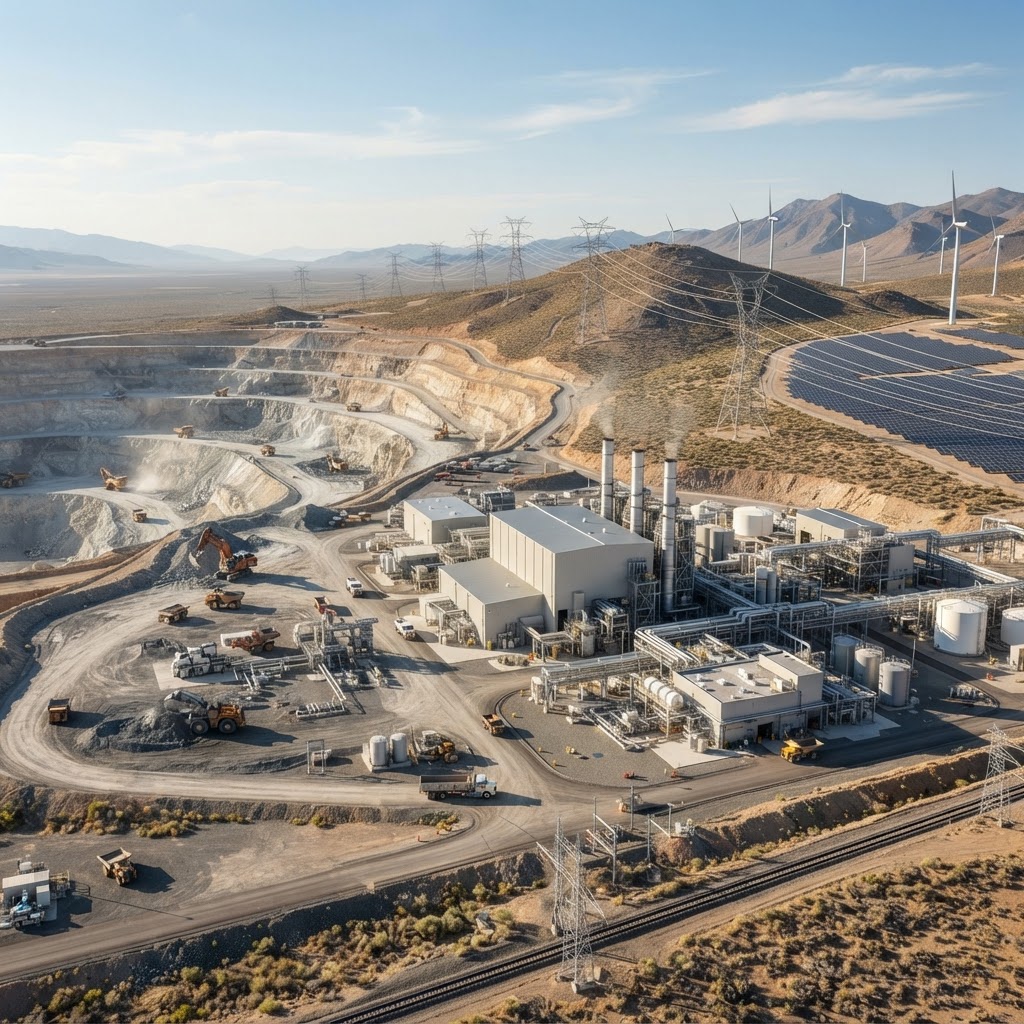
The U.S. Department of Energy has finalized a $996 million loan guarantee to Ioneer Rhyolite Ridge LLC, securing federal debt financing to develop an integrated lithium and boron mining and processing facility in Esmeralda County, Nevada. The financial closing, handled by the DOE Loan Programs Office, represents a milestone for domestic battery supply chain policy. Comprising $968 million in principal alongside $28 million in capitalized interest, the package provides investor-grade federal credit support to build out an essential processing nexus aimed at anchoring electric vehicle component manufacturing on American soil.
Key Findings
The finalized federal guarantee leverages Title XVII statutory authority to fund commercial-scale extraction and refining facilities for battery-grade lithium carbonate. Once operational, the Rhyolite Ridge operation is engineered to generate roughly 20,600 metric tons of lithium carbonate annually—a volume capable of supplying batteries for hundreds of thousands of electric vehicles each year. In addition to lithium, the processing plant will co-produce significant volumes of boric acid, diversifying cash flows and shielding the operation against single-commodity spot price volatility.
The capital structure combines federal low-cost debt with private equity deployment, effectively de-risking advanced development phases while satisfying stringent federal community benefit standards. Project sponsors anticipate the construction campaign will generate roughly 500 engineering and building jobs, transitioning into several hundred permanent technical roles during commercial operations. By establishing domestic refining capacity, the project directly addresses federal policy imperatives to cut reliance on overseas chemical converters, primarily concentrated in East Asia, while integrating into the expanding battery gigafactory corridor across North America.
Industry Response
Institutional capital and automotive original equipment manufacturers welcomed the transaction as an affirmation of long-term federal credit backing for strategic supply chains. Market analysts pointed out that securing non-dilutive, sovereign debt underpins project bankability during periods of fluctuating lithium carbonate indices, offering stability that private syndicated commercial credit alone often struggles to provide for greenfield critical mineral assets.
Energy policy specialists at the EFI Foundation highlighted that the DOE's loan mechanism serves as an indispensable bridge to commercial scale, proving that novel domestic refining models can clear technical and environmental hurdles. Supply chain strategists for domestic automakers underscored that guaranteed off-take from domestic facilities eliminates major maritime shipping bottlenecks and hedges geopolitical supply shocks. However, natural resource development advocates and mining sector analysts noted that executing on aggressive construction schedules will require careful environmental monitoring and proactive alignment with local stakeholders, given Nevada's unique desert hydrology and rigorous federal permitting protocols.
What's Next
With senior debt formally obligated and closed, Ioneer is advancing EPC contracts, procurement packages, and specialized chemical processing equipment orders to launch full-scale commercial site construction. Project engineering timelines target first commercial output of lithium carbonate before the late-decade demand surge anticipated from North American battery manufacturers.
From a regulatory and market standpoint, the project will move through regular construction monitoring overseen by federal independent engineering monitors to satisfy loan draw conditions. Concurrently, the DOE Loan Programs Office continues to work through a multi-billion-dollar pipeline under expanded Title XVII authority, signaling further loan guarantee allocations for grid modernization, transmission hardware, and domestic critical mineral processing hubs throughout this fiscal year.