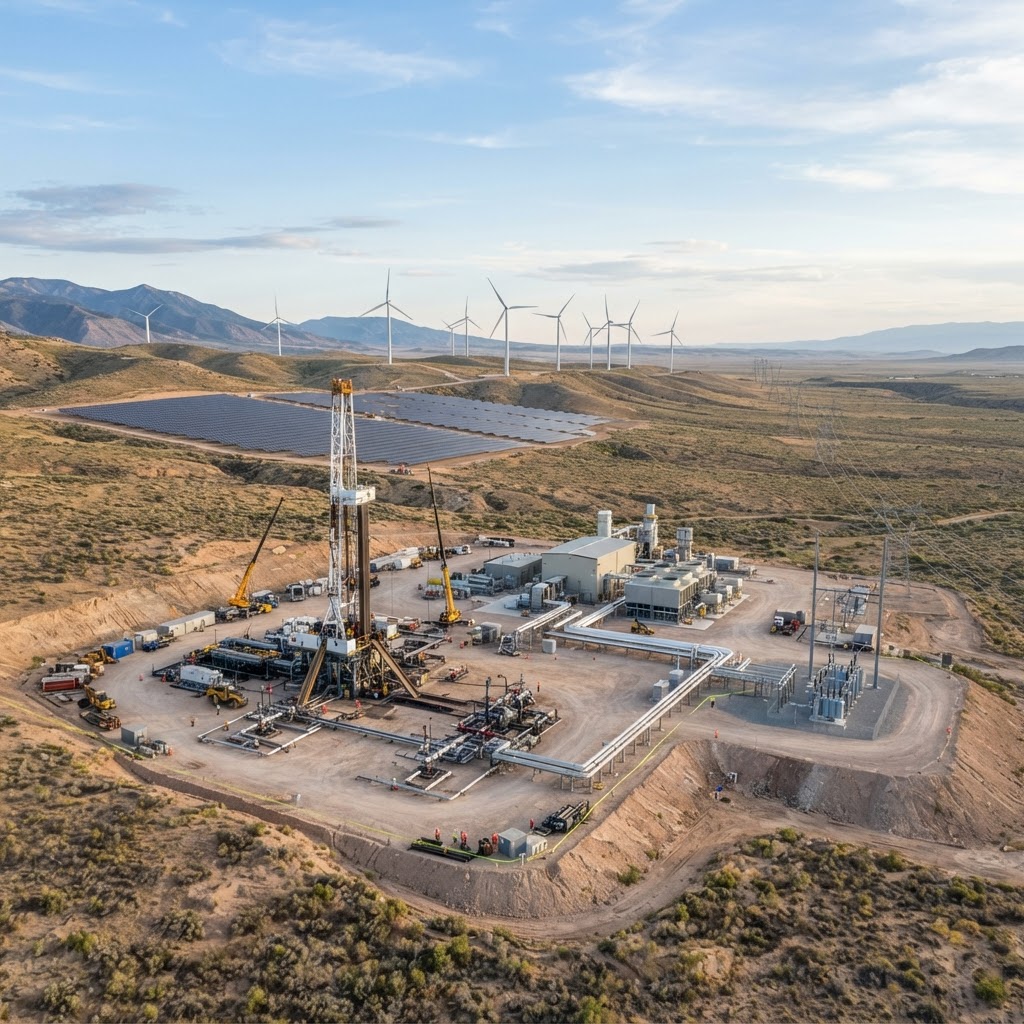
Fervo Energy is hitting critical operational milestones at its flagship Cape Station project in Beaver County, Utah, signaling a major leap forward for next-generation geothermal power. As the company advances toward its late 2026 commissioning target, it has successfully completed its Phase I wellfield drilling, setting new industry records for speed and depth. With over $2.1 billion in cash reserves and $7.2 billion in contracted revenue, Fervo is effectively scaling its enhanced geothermal systems (EGS) to meet the surging demand for firm, 24/7 carbon-free electricity from AI hyperscalers and regional utilities. This progress underscores geothermal’s transition from a niche resource to a core, bankable asset class for the modern grid.
Key Findings
The Cape Station development represents a benchmark for utility-scale EGS, with 400 megawatts of capacity now in advanced development. Fervo’s recent second-quarter 2026 results highlight a robust financial position, supported by $462 million in Series E funding and significant non-recourse project debt financing. By leveraging drilling techniques pioneered in the oil and gas sector, the company has achieved a 70% reduction in drilling time compared to historical baselines, significantly lowering the levelized cost of energy. The project is currently contracted to supply 658 megawatts of baseload power, providing a reliable, weather-independent alternative to intermittent renewables. This industrial approach to geothermal—characterized by repeatable, high-performance drilling—is effectively removing the resource risk that has historically hindered the sector’s expansion, making it an increasingly attractive target for infrastructure lenders and institutional investors seeking long-term, stable returns in the energy transition.
Industry Response
Financial and industry leaders are increasingly viewing EGS as a vital component of American energy security. Sean Pollock, managing director of Project Finance at RBC Capital Markets, noted that as demand for firm, clean power accelerates, EGS is rapidly becoming a core energy asset class for infrastructure lenders. The project has garnered support from a diverse syndicate of global financial institutions, including J.P. Morgan, Bank of America, and HSBC, which served as lead arrangers for the project’s debt facilities. Furthermore, the U.S. Department of Energy has recognized Cape Station as a model for the industry, selecting it for federal funding under the EGS Pilot Demonstrations program. This institutional backing reflects a broader market consensus that next-generation geothermal is essential for balancing the grid as coal and gas plants retire, providing the necessary baseload capacity to support the massive energy requirements of modern data centers and industrial electrification.
What's Next
The immediate focus for Fervo Energy is the final integration of the Phase I power plant facilities, with initial grid synchronization scheduled for the fourth quarter of 2026. Following this, the company aims to reach 100 megawatts of operating capacity by early 2027, with a clear pathway to scale the total project to 500 megawatts by 2028. Beyond the physical construction, the company is expanding its mineral-rights holdings, which now exceed 650,000 acres, providing a long-term pipeline for future development. Policymakers and industry analysts are also watching for potential updates to federal and state regulatory frameworks that could further streamline geothermal permitting and royalty structures. As Fervo continues to prove the scalability of its technology, the industry expects a ripple effect, with more developers adopting EGS techniques to unlock geothermal potential in regions previously considered inaccessible, ultimately driving the cost of firm, clean power toward the DOE’s target of $45 per megawatt-hour by 2035.