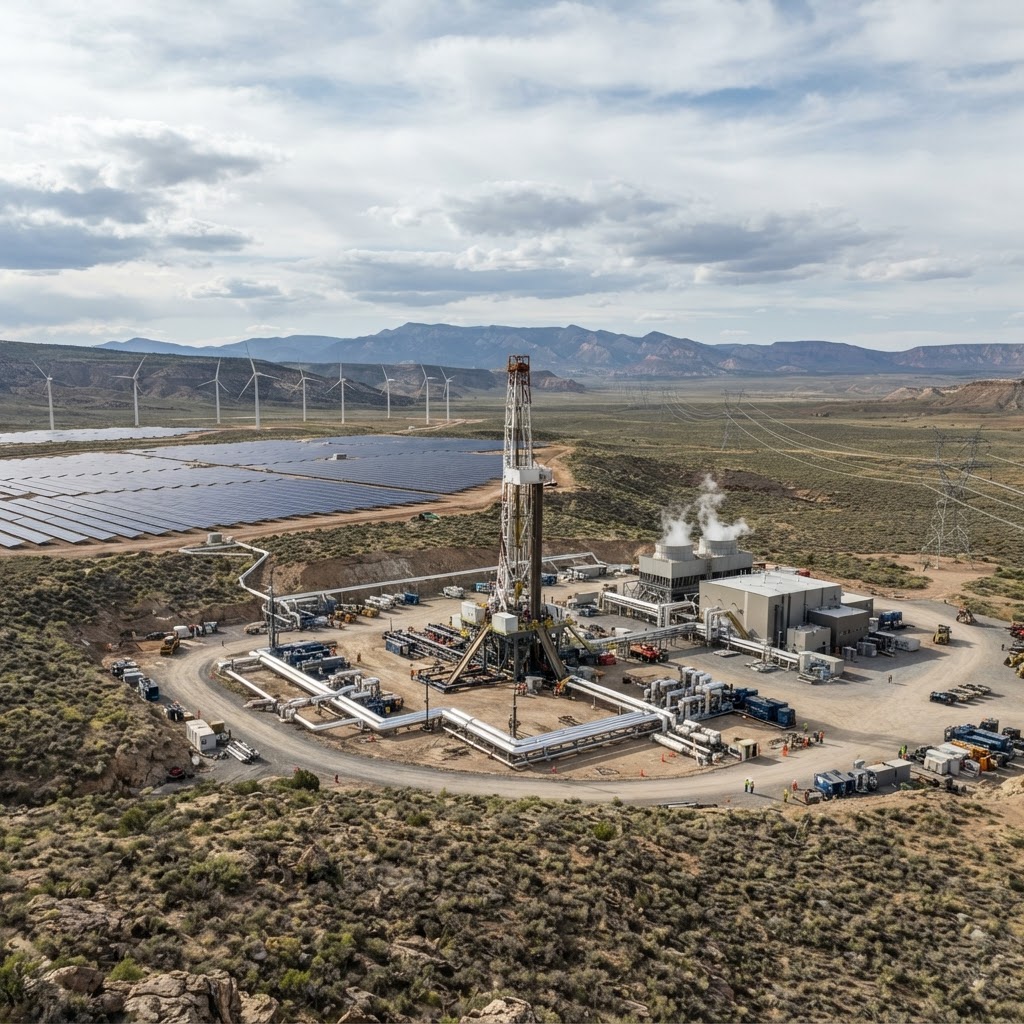
Fervo Energy has successfully closed $421 million in non-recourse project financing for its flagship Cape Station development in Beaver County, Utah. This capital infusion marks a critical inflection point for the company’s enhanced geothermal systems (EGS), validating the technology as a bankable, utility-scale solution for the U.S. power grid. As the world’s largest EGS project, Cape Station is engineered to provide 400 megawatts of firm, carbon-free baseload power. With construction well underway and first power delivery slated for 2026, the project is positioned to play a pivotal role in meeting the surging electricity demands of AI hyperscalers and regional utilities seeking reliable, non-weather-dependent energy.
Key Findings
The $421 million financing package underscores a growing institutional appetite for next-generation geothermal assets that can bridge the gap left by intermittent renewables. By leveraging advanced drilling techniques adapted from the oil and gas sector, Fervo has demonstrated that EGS can be deployed with repeatable, industrial-scale efficiency. The project’s financial structure provides a blueprint for future geothermal developments, proving that non-recourse debt is increasingly accessible for innovative clean energy technologies. Furthermore, the project’s integration with the grid is supported by long-term power purchase agreements, including a 320 MW commitment from Southern California Edison. This contractual stability is essential for de-risking the asset for private investors and demonstrates the clear market signal for 24/7 carbon-free energy. As the project moves toward its 2026 commissioning, it serves as a bellwether for the broader geothermal sector’s ability to scale rapidly.
Industry Response
The industry has responded with strong support, viewing the financing as a validation of EGS as a core component of the energy transition. California Energy Commission Chair David Hochschild noted that projects like Cape Station are essential for grid reliability, providing critical baseload power when wind and solar resources are limited. Analysts emphasize that the deal highlights the scarcity of firm, clean power, particularly as data center demand accelerates. Fervo’s ability to attract both private capital and utility-scale offtake agreements has been cited by market observers as a turning point for the sector. Partners such as ABB, which is supplying advanced motor control solutions, have also signaled confidence in the project’s technical rigor. By successfully navigating the complex diligence processes required for such a large-scale deployment, Fervo has effectively moved EGS from a niche experimental technology to a mainstream, investable asset class that utilities and hyperscalers are actively integrating into their long-term procurement strategies.
What's Next
The immediate focus for Fervo Energy is the commissioning of the first 70 MW phase of Cape Station, which remains on track for delivery to the grid in 2026. Following this initial milestone, the company plans to scale the facility to its full 400 MW capacity by 2028, with potential for further expansion thereafter. Investors and policymakers will be closely monitoring the project’s operational performance and cost-reduction curves, which are expected to influence future federal and state-level geothermal policy. Additionally, the company is expected to continue exploring the potential for critical mineral recovery from geothermal brines, a secondary value stream that could further enhance project economics. As the industry watches the progress in Beaver County, the success of Cape Station is likely to catalyze additional funding rounds and policy support for EGS, potentially accelerating the deployment of similar projects across the Western United States and beyond.